No. 030 of 460 · AI and Computing · Built from a recipe
Perceptron
A perceptron is the simplest artificial neuron, described by Frank Rosenblatt in 1958.
- Shelf
- AI and Computing
- Kind
- Built from a recipe
- Sound
- Yes
- Hands-on
- Yes
- Licenses
- Own work (made in the page)
How to play
Tap it to try an example. Hands-on: tap an input lamp to switch it; the output updates.
Its controls
| Control | Kind | Range | Start |
|---|---|---|---|
| Try an example | Tap | ||
| Try | Button | ||
| Flip | Button | ||
| View | List | 2 choices | Poster (2D) |
About it
A perceptron is the simplest artificial neuron, described by Frank Rosenblatt in 1958. It takes a few inputs, multiplies each by a weight (how much that input counts), and adds them up. If the sum passes a threshold, it fires: its answer is 1, otherwise 0. It learns by nudging its weights each time it gets an answer wrong.
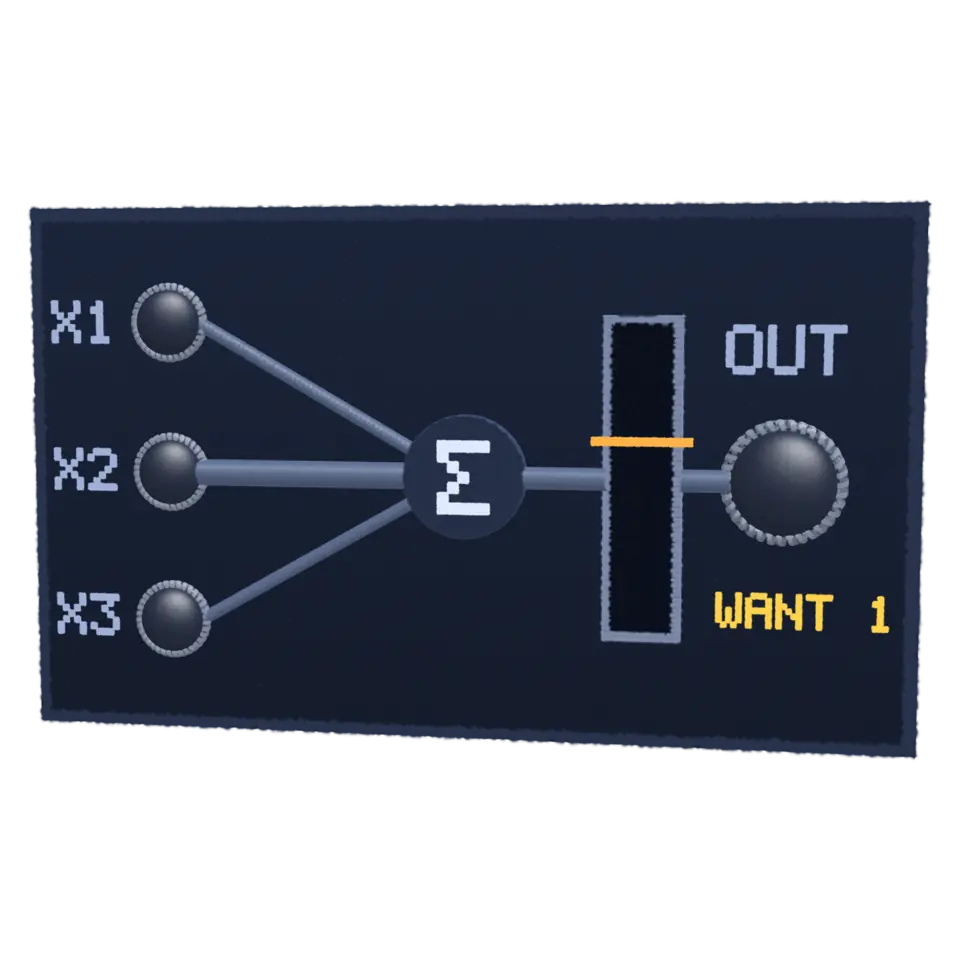
Tap it: inputs X1 and X3 light up and send pulses along wires as thick as their weights. The sum fills the gauge but stays under the threshold line, so the lamp flashes red. The two live wires thicken, the pulses go again, the gauge passes the line and the lamp lights gold. Pick the flat poster or a 3D model in the Splash tab. This repeats a scripted learning example; it does not keep training on your taps. With ✋ Hands-on on, tap an input lamp to switch it on or off: the sum, the gauge and the output lamp show the perceptron's answer at once, with its learned weights.
Details
- Splats
- Opens at 200,000 at Mid Detail, 120,000 at Low, and up to 710,000 at Max
Is it right?
The weighted sum and threshold example are consistent with a perceptron. The weight change is a prepared learning example, and tapping does not train a new model.
Correct
A perceptron sums weighted inputs and applies a threshold.1
Inputs 1, 0, 1 give sums 0.35 before and 1.35 after, with threshold 1.
Simplified
The weight change illustrates a learning update.1
Adding 0.5 times each active input gives the stored second weight set, but the update is not calculated from a live training example.
Correct
Rosenblatt described the perceptron in 1958.1
The About text now dates the published description, instead of asserting a precise invention year.
- 1The perceptron (1958), Frank Rosenblatt, Psychological Review
- Simplified
- Three fixed inputs and two stored weight sets repeat on each tap. There is no training dataset, learned bias, or ongoing optimizer.
Sources and credits
Made in Splashery. Its code is MIT.
Back to the machineThe AI and Computing machine